Pre-Purchase Classic Car Check: A Step-by-Step Guide
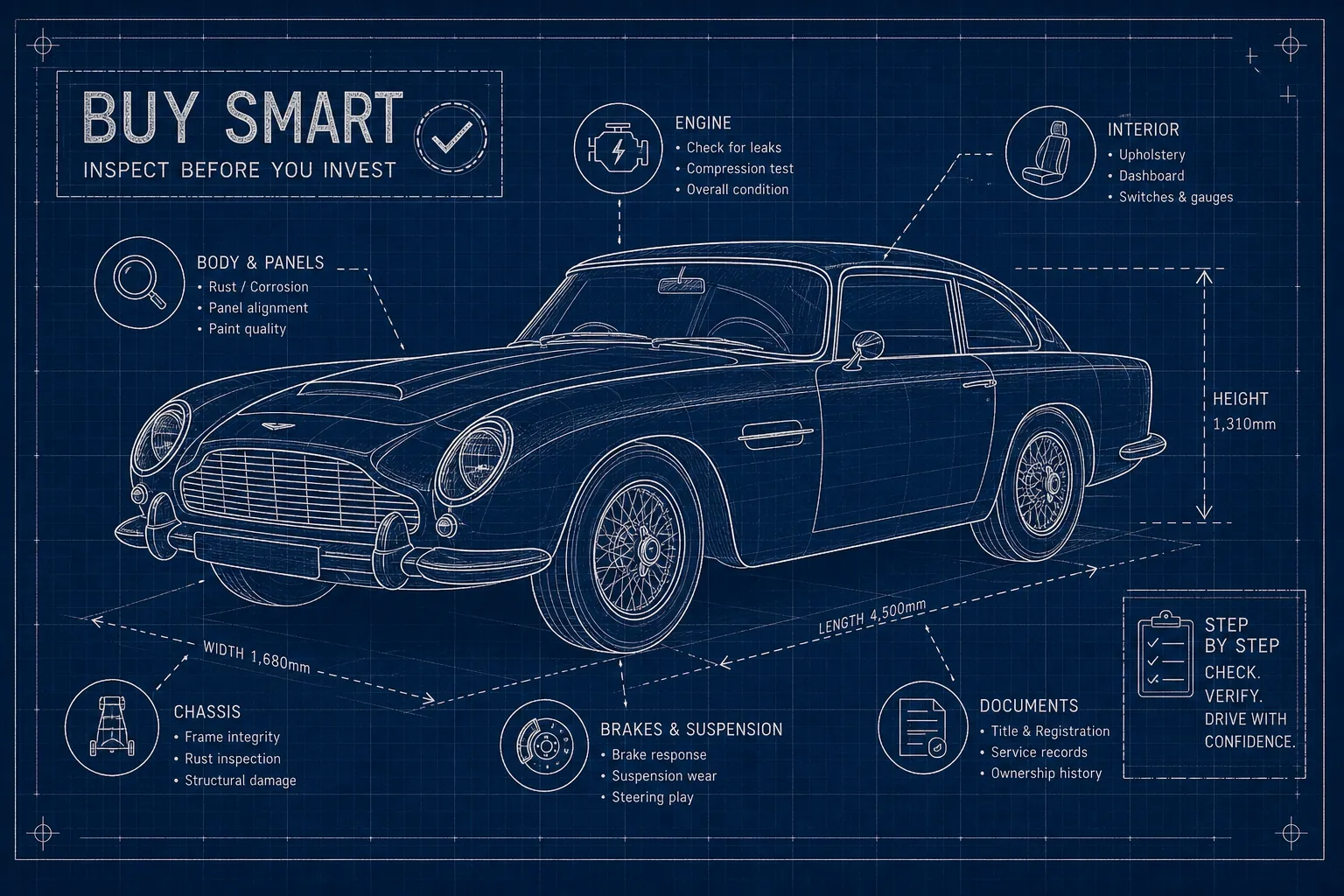
You’ve found the car. The photographs look promising, the seller sounds knowledgeable, and the listing ticks most of the boxes on your mental checklist. The temptation to move quickly is entirely understandable. Before you commit, however, a pre-purchase classic car check is the single most reliable way to confirm that what you are buying matches what you have been told. Skipping it is how buyers end up with structural rot hidden beneath fresh underseal, rewired electrics that worked on a dry summer afternoon, and a paperwork trail that quietly unravels under scrutiny.
Experienced specialist dealers, the kind of business that builds its reputation on doing things properly, understand that a thorough inspection protects everyone involved. Buyers who know what a rigorous check looks like are far harder to mislead, and far more likely to complete a purchase with confidence rather than regret. This guide covers which areas to examine, which questions to ask, which warning signs mean you should put your wallet away, and how to find an inspector worthy of the task.
What a thorough pre-purchase classic car check covers
A proper inspection is not a quick look-over in a driveway. It is a structured, methodical process that moves through six distinct areas, bodywork, the underside and chassis, engine and mechanicals, provenance and documents, red flags, and the seller conversation, and any inspector worth hiring should be working to this standard. If a seller suggests a brief visual check is sufficient, treat that as a warning sign in itself.
Bodywork, paint, and panel condition
Start with panel gaps. Uneven gaps between doors, bonnet, and boot lid suggest either a past accident or a body that has shifted over time. Paint that changes slightly in shade under different light is a reliable indicator of previous repair work. Pay particular attention to wheel arches and sill edges, where bubbling paint is often the first visible sign of corrosion working outward from beneath. A small magnet dragged along the panels will reveal body filler, which is common on classics but should be declared, not disguised.
Chrome trim that is lifting, pitting, or separating from the substrate is worth noting, though it rarely affects structural integrity. Surface rust on a 50-year-old car is expected and largely forgivable. Structural corrosion is an entirely different matter, and it begins in the areas the bodywork hides.
Underside and chassis integrity
This is where classic car inspections differ most sharply from a standard used-car check. A proper underside examination requires a ramp, a torch, and a willingness to get close. The inspector should look carefully at chassis rails, jacking points, floor pans, subframe mounts, and any visible repair welds. These are the areas where corrosion becomes structural, and where the real cost of a project car accumulates.
Do not take fresh underseal as reassurance. It can be newly applied to conceal corrosion beneath. Probe the metal with a screwdriver around jacking points and sill edges; soft metal that gives under pressure is a serious concern regardless of how clean the paint looks from a distance.
Engine bay, mechanicals, and the test drive
In the engine bay, look at oil condition, fluid levels, visible leaks, hose condition, and belt wear. A recently pressure-washed engine is worth noting; it can mask slow leaks that would otherwise be obvious. On older engines, a compression or leak-down test gives a far more accurate picture of internal condition than a visual check alone, and a good inspector will include this where it is feasible.
The road test should confirm cold-start behaviour, steering feel, smooth gear selection, progressive brake response, and the absence of unusual noises under load. A car that starts well when warm but struggles from cold is telling you something. A car that pulls to one side under braking is telling you something different, but equally important.
Verifying provenance and the paper trail
A classic car’s documentation is as important as its physical condition. A vehicle with clear, continuous paperwork often commands a premium on the market, tends to be treated more favourably by specialist insurers, and carries considerably less risk for the buyer. Expect a complete paper trail and ask for it early.
V5C, MOT history, and service records
Check the V5C carefully: does the seller’s name match? Does the address history align with what they have told you about the car’s storage and use? Run a full MOT history check via the GOV.UK service, which is free and genuinely revealing. It shows pass and fail results, recorded mileage at each test, and any advisories. Cross-referencing the mileage figures across several years of MOT records is one of the simplest and most effective ways to identify a discrepancy. Gaps in MOT history are not automatically disqualifying, but they need an explanation.
A stamped service history or a documented record of specialist work adds real value. The absence of any paperwork beyond the V5C does not make a car unbuyable, but it does change the price conversation.
Matching numbers, chassis stamps, and an HPI check
For British classics, matching numbers means the engine number stamped on the block matches what is recorded on the V5C, and that the chassis plate corresponds to factory records. Marque clubs and registries can often verify original build specifications, particularly for Jaguars, Triumphs, and Morgans, where production records are reasonably well preserved. An HPI check, which typically costs around £20 at basic level, will confirm whether the vehicle has outstanding finance against it, has been recorded as written off, or appears on the stolen vehicle register. Run it before you travel to view the car, not after.
Classic car valuation and how a pre-purchase check informs it
Understanding a car’s market value and its intrinsic value are two different exercises, and a pre-purchase classic car check bridges both. Market value reflects what comparable examples are selling for; intrinsic value accounts for the specific car’s condition, originality, provenance, and restoration quality. A thorough inspection gives you the evidence to assess where this particular car sits relative to others. A vehicle with confirmed matching numbers, a verifiable service history, and no hidden corrosion will justifiably command more than a similar model with gaps in its story. Conversely, faults uncovered during the check, whether structural, mechanical, or documentary, become the basis for negotiation or, in serious cases, grounds to walk away. Without that inspection data, classic car valuation is little more than guesswork.
Red flags that should make you walk away
There are situations where negotiating a lower price is the wrong response. Some findings make a car too risky to buy at any price, and recognising them early saves significant time and money.
Structural rust and hidden repair work
Surface patina on a classic is forgivable; structural corrosion is not. On British classics, the specific danger zones are floor pans, inner sills, rear chassis legs, jacking points, and suspension turrets. These areas are load-bearing and their integrity directly affects safety. Obvious weld repairs around these points, particularly rough-quality work with heavy grinding marks, suggest the car has already had major corrosion remediation that may be incomplete, undocumented, or both. Walk away unless you have a clear account of what was done, by whom, and when.
Paperwork problems and seller behaviour
No V5C present at viewing is a serious red flag. A VIN that does not match the log book is a serious red flag. A seller who refuses an independent inspection, cannot account for where the car has been for a significant period, or insists that “it has to go this weekend” is providing you with useful information. It is not the information they intend to give, but it is information nonetheless. A genuine seller with a good car has no reason to obstruct due diligence.
Electrical faults and signs of amateur work
Wiring is one of the most expensive systems to address properly on a classic car. Taped joints, fused bypasses in the loom, non-working gauges, and lights that flicker under load are all warning signs. Amateur electrical work spread across a harness can accumulate rectification costs that rival or exceed a major mechanical rebuild, and the faults are often intermittent, which makes them harder to price and harder to fix. If the instrument panel looks like a second attempt at something, factor that in carefully.
The right questions to ask the seller before you inspect
The seller’s answers, and how they answer, tell you almost as much as the car itself. Prepare your questions in advance and ask them before you travel anywhere.
Ownership, storage, and use history
Ask directly: how long have you owned it? Where was it stored, and was that dry, indoor storage or outside? Was it used regularly or laid up for periods? How many previous owners are recorded? Does the recorded mileage make sense given the ownership history? An honest seller with a car they know well will answer these questions without hesitation. Vague or inconsistent replies, particularly about storage conditions, are worth pressing on.
Known faults, recent work, and the asking price
Ask what the car needs. Ask what work has been carried out in the last two years, and by whom. Ask why they are selling. A seller who has invested in the car and is proud of the result will almost always be forthcoming; they want you to understand what you are buying. A seller who deflects or falls back on “it just needs a good polish” is, in their own way, answering the question.
How to commission a pre-purchase classic car check: finding and briefing an inspector
For any significant classic car purchase, an independent inspector, someone with no financial interest in whether the sale completes, is strongly recommended. Their fee is the best money you will spend in the whole process.
What makes a specialist inspector qualified for classics
Not every vehicle inspector is equipped to assess a classic car properly. Look for inspectors with demonstrable marque-specific experience and references from other classic car buyers. Formal qualifications such as an IMI Level 3 Diploma in Classic Vehicle Restoration Competence, or membership of recognised professional bodies, indicate genuine technical grounding. Marque clubs often maintain their own lists of recommended engineers, which is a reliable starting point for the specific model you are considering.
What a UK pre-purchase inspection typically costs and how to brief your inspector
A realistic budget for a specialist classic car pre-purchase inspection in the UK is £150 to £300, depending on the vehicle, the inspector’s location, and the depth of the report. Brief the inspector before they go: share the listing, note any concerns that arose during your conversation with the seller, and request a written condition report with photographs covering the underside, bodywork, engine bay, and documentation check. Confirm they will conduct a road test. A report without photographs is not a report you can use in negotiation or share with an insurer.
Buying with confidence when you can’t inspect in person
Geography, work commitments, or the simple reality of purchasing cross-country means that visiting in person is not always possible. This is where the inspection process either builds trust or exposes a seller’s unwillingness to be transparent.
The case for detailed walk-around videos and seller transparency
An honest seller should provide a thorough walk-around video covering every panel, the underside, the engine bay, and a cold start. Done properly, this is not a marketing exercise; it is an evidence package. A seller who offers only well-lit showroom-angle photographs and declines to show the sills or the underside in real time should be treated with appropriate caution. The willingness to show everything, including the imperfections, is one of the clearest signals of a straightforward transaction.
How Fine Lines Classic Cars approaches remote buying
At Fine Lines Classic Cars, the pre-sale process is built around exactly this principle. Detailed walk-around videos are prepared specifically to help remote buyers assess condition honestly, without needing to make a long journey on the strength of a listing. The approach is to answer provenance questions directly, disclose known issues openly, and provide the kind of evidence a serious buyer needs to make a confident decision. That is one benchmark worth considering when assessing any specialist dealer.
The inspection is the purchase
A reliable pre-purchase inspection combines a methodical physical inspection with a thorough document review and well-prepared questions put to the seller. It is not about distrust; it is about buying with clarity. The cost of a proper pre-purchase inspection, whether that is £150 for an independent specialist or the time spent working through this checklist yourself, is always less than the cost of a car that turns out to need major remedial work.
Whether you are buying through a specialist dealer or privately, the standard is the same: full transparency on condition, honest disclosure of known issues, and a paper trail that holds up under scrutiny. A thorough pre-purchase classic car check is the single best way to ensure that the car you fall for is everything it appears to be. If you would like to browse vehicles presented to this standard, take a look at the Fine Lines Classic Cars current inventory. If you have questions before making a purchase decision, get in touch directly — that conversation costs nothing.